
Yard Drainage That Ends the Standing Water
When your yard holds water for days after a storm, the water has no way out. A yard drainage system gives it one. We pick the water up at the wet spots, carry it through pipe buried under the lawn, and release it at a safe discharge away from your home.
Trufam designs each system around the yard it has to fix, with commercial-grade materials and access points that keep it serviceable for years. We are not the cheapest drainage company in Tampa Bay, and the homeowners who call us are usually done paying for fixes that did not hold.
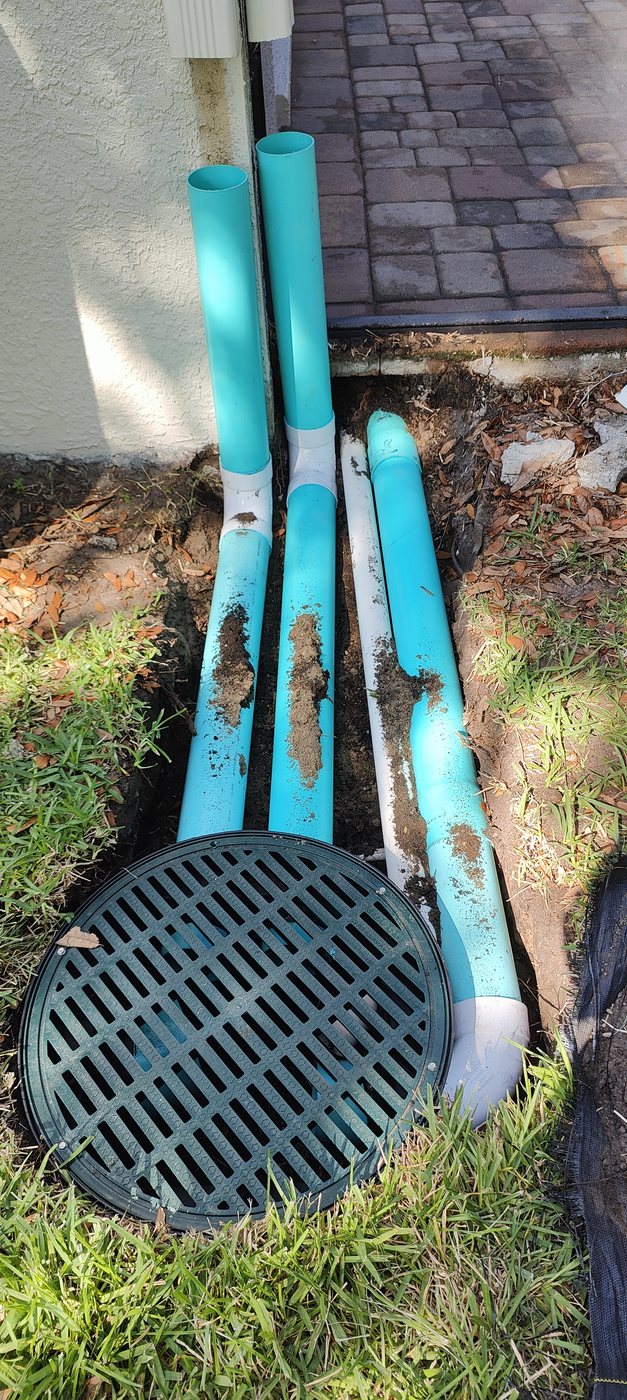
A Yard That Never Gets a Chance to Dry
Tampa Bay yards take on more water than almost anywhere in the country. The lots are flat, the water table sits high, and the summer pattern drops an inch or two of rain in an afternoon, day after day. A lot of yards were also graded fast during construction, leaving low spots that nobody notices until the first wet season.
When the water sits, the damage builds quietly. Grass drowns in the low spots, the soil stays saturated, mosquitoes move in, and every storm pushes a little more water toward the foundation. A soggy yard is the early warning, and it only gets more expensive to ignore.
Yard drainage fixes it at the source. We find where the water collects and where it comes from, then build it a path out: collection points at the wet spots, sealed pipe under the lawn, and one controlled exit away from everything you are trying to protect.
When You Need Yard Drainage
- Standing water a day or more after the rain stops
- Soggy turf that squishes underfoot all summer
- Low spots that turn into ponds every storm
- Grass dying in the same wet areas year after year
- Mosquitoes breeding in the wet ground
- Erosion lines or mud washing across the yard
- A neighbor's runoff draining onto your lot
- Wet ground creeping toward the house or lanai
What a Yard Drainage System Looks Like
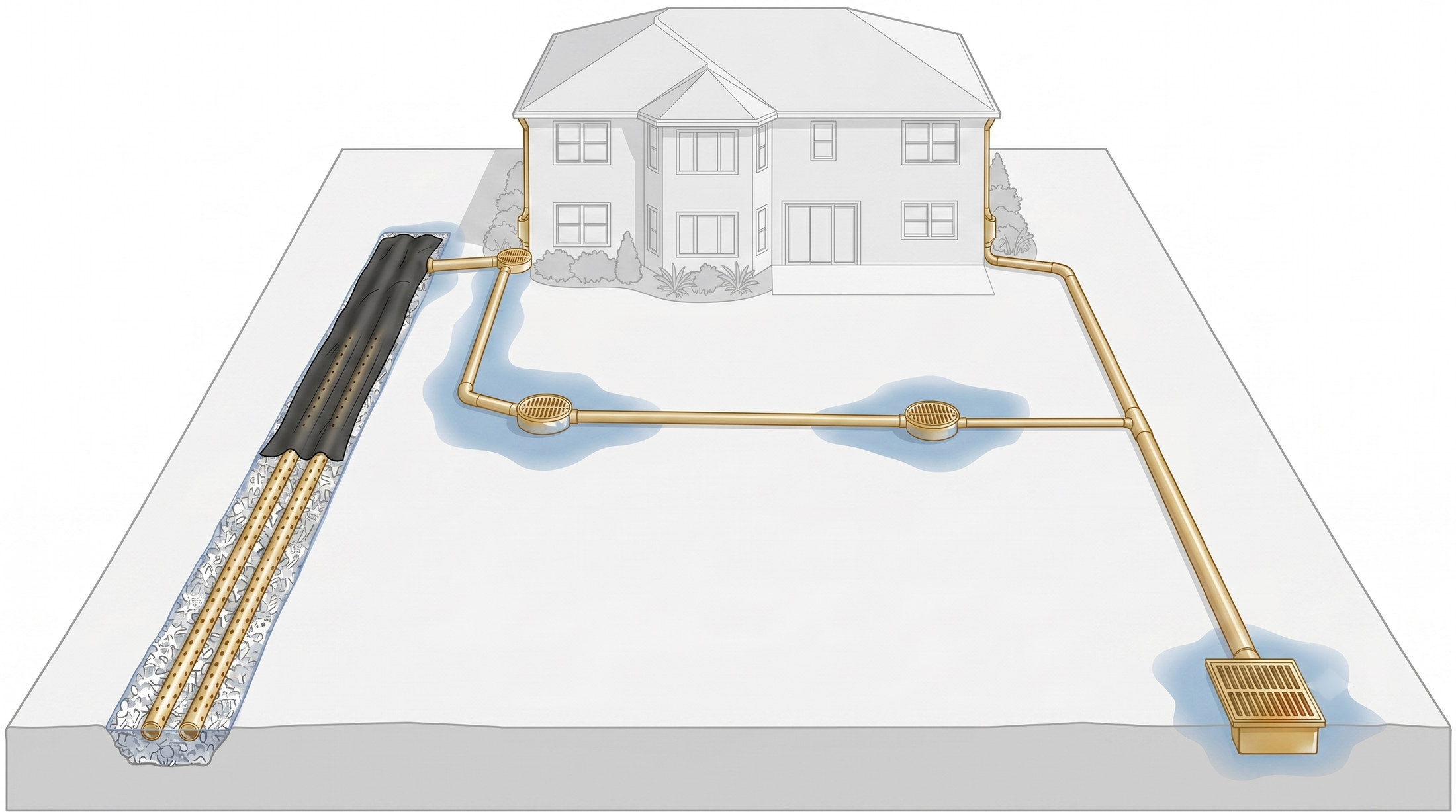
Yard drainage is rarely one product. It is the right combination of tools, sized to your property and tied into one path out. The numbers on the diagram match the pieces below.
 1
2
3
3
4
4
5
6
1
2
3
3
4
4
5
6
French drain for the soaked-in water
Where the ground itself stays saturated, a French drain pulls the water out: two perforated pipes bedded in clean #57 granite, collecting groundwater along the full run. Two pipes is our minimum standard on every French drain we build.
Real drainage fabric, closed tight
DOT-grade geotextile fabric wraps the entire stone bed and closes over the top, so soil stays out while water passes through. Real drainage fabric is rated for about 50 years in the ground; weed barrier lasts a couple of years, and we never use it. The dug-out dirt is hauled away, and the trench is finished with sod or stone to match the yard.
Downspouts on their own lines
Roof water is part of the same problem, so each downspout ties into its own sealed line with a metal cleanout at the wall that catches debris and gives the line a service point. If the gutters above it are undersized or failing, we address them in the same project.
Catch basins at the low spots
Grated catch basins sit flush in the lawn right where the water ponds. Standing water falls through the grate instead of soaking the turf, the basin traps sediment in one easy-to-clean spot before it can reach the buried pipe, and each one doubles as a service access point.
Solid pipe runs under the lawn
Everything the system collects moves through solid SDR-35 PVC set on flat trench bottoms with proper pitch we check with a level, no bellies where water can sit. Smooth walls flush debris through, and the runs drain dry between storms.
A discharge sized for storms
The system ends at a controlled exit: a grated discharge basin or daylight outlet, often protected with rip rap stone, that can release a full storm as fast as it arrives. We do not end a system at a pop-up emitter, which restricts flow and clogs right when you need it most.
Three Kinds of Water, One Way Out
A wet yard usually has more than one water source feeding it, and each one needs a different tool. Ground water that has already soaked in. Surface water standing in the low spots. Roof water pouring off the downspouts. Treat the wrong one and the yard stays wet.
That is why we read the water before we design anything. We walk the property, in the rain when the timing works, and map where every gallon comes from and where it can safely go. Then each source gets the right tool, and every tool drains to the same controlled exit.
Water soaked into the soil that keeps the yard saturated for days. A French drain reaches down to where it sits and pulls it out.
Rain standing in low spots or sheeting across hard surfaces. Catch basins and channel drains pick it up right where it collects.
Hundreds of gallons per storm, concentrated at a few downspouts. Sealed solid lines carry it through the yard without ever touching the lawn.
Every source ties into the same discharge, sized for the full storm, protected so it never erodes, and easy to check after a hurricane.
Designed Around Your Yard, Not Pulled From a Kit
Every yard falls differently, drains differently, and collects water in its own places. Before we quote anything, we walk the property and read the grade, the wet zones, and the discharge options. Then we size every trench, basin, and pipe to match. Gravity does the work wherever the lot allows, and we only add a custom sump system when the water truly has no downhill path out.
We are not the lowest bid, and we do not aim to be. You are paying for a system designed to your property, commercial-grade materials in the ground, and access points that keep it serviceable for the long run. Premium drainage is an investment that protects a far larger one, your home.
And when the work is done, we put the yard back. Sod goes back over the trenches, the excavated dirt gets hauled away, and a few weeks later most people cannot tell where we dug.
What You Get With Trufam
- A system designed and sized to your yard
- Clean #57 granite and DOT-grade fabric, never weed barrier
- Solid SDR-35 pipe, never corrugated
- Catch basins that trap sediment before the pipe
- Gravity-fed design, sump pumps only when needed
- A controlled discharge, not a pop-up emitter
The Tools Inside a Yard Drainage Plan
If you do not work in drainage every day, it is natural to call all of this a French drain. Each tool handles a different kind of water, and most Tampa Bay yards need two or three of them working together.
French drain
Perforated pipe in a fabric-wrapped granite trench that pulls out water already soaked into the ground.
Best for: saturated soil and high groundwater. See French drains.
Underground drainage
Sealed solid pipe that picks up roof water and surface inlets and carries everything to one controlled discharge.
Best for: downspout runoff and moving water off the lot. See underground drainage.
Channel drain
A surface drain set flush into concrete or pavers that catches water sheeting across driveways, patios, and pool decks.
Best for: hard surfaces that pool. See channel drains.
What Shapes the Scope and the Price
No two wet yards are the same job. The price follows how much water the yard takes on, how many places we have to pick it up, and how far it has to travel to leave safely. At the walkthrough we lay out exactly what we would build and why each piece belongs in the design, before any number is set.
Most homeowners who call us have already tried the cheap route once. Drainage built to last costs more than a trench and a roll of corrugated pipe, and it is the version that still works ten years from now.
- How many wet areas and water sources feed the yard
- French drain runs versus catch basins versus both
- Total length and depth of the trench runs
- Downspout tie-ins and any hard-surface drains
- Distance to a safe discharge and how the lot falls
- Sod or stone restoration when the work is done
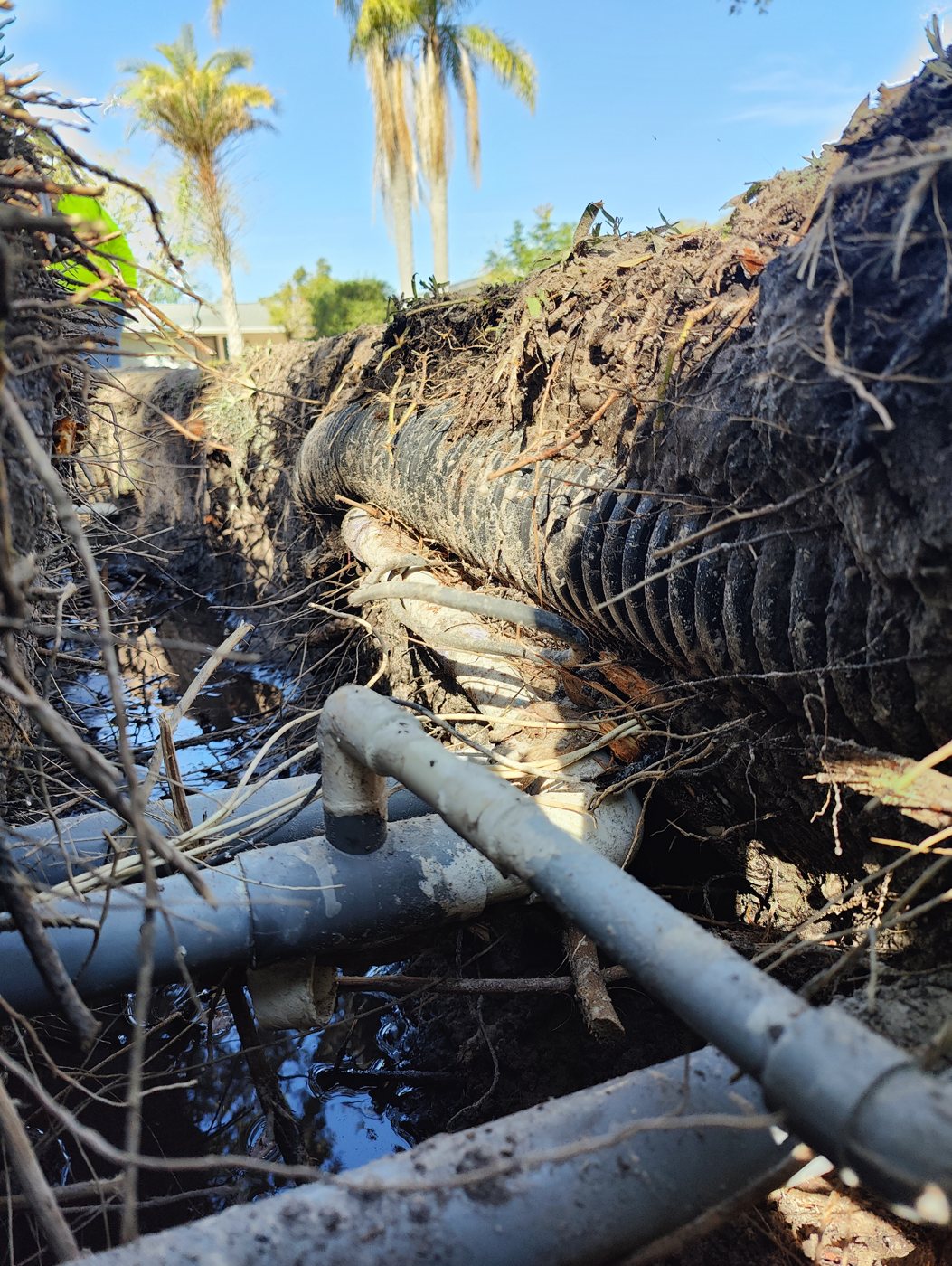
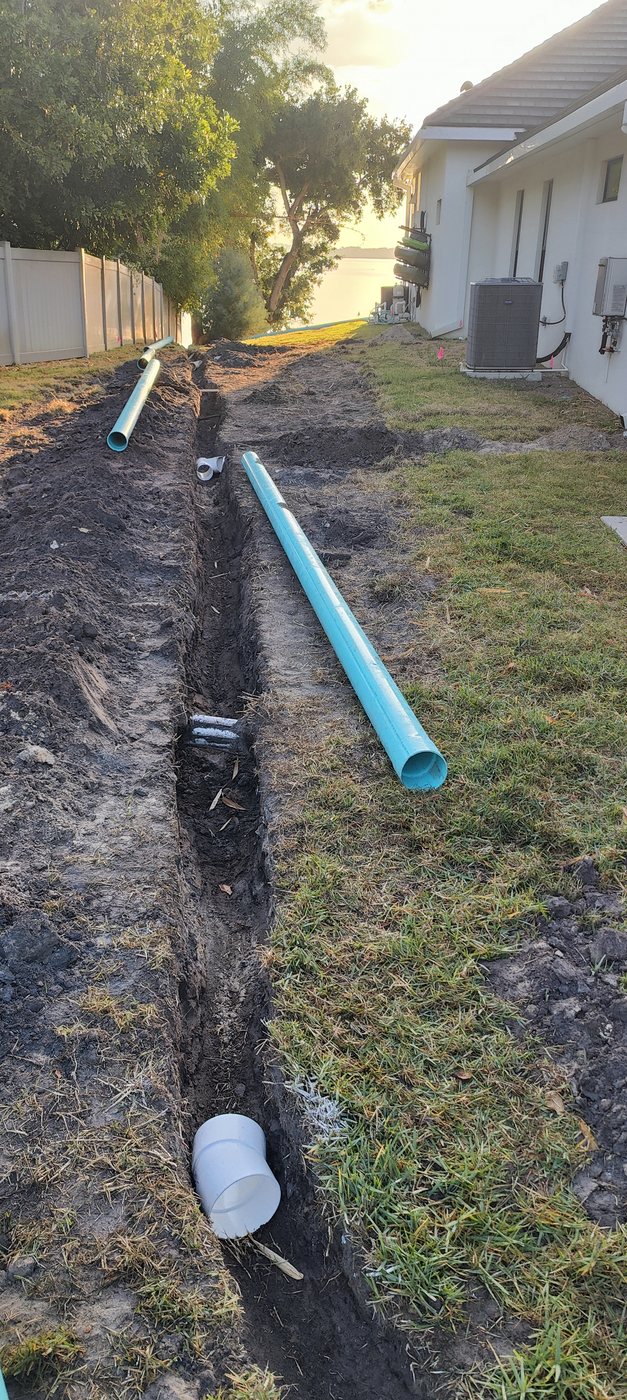
Yard Drainage Projects in Tampa Bay
Why Yard Drainage Matters on Florida Lots
Florida yards sit on sandy topsoil over layers of clay and a high water table. The sand drinks the first storm fast, the clay stops it, and by the second or third day of the summer pattern the ground is full and the rain starts collecting on top. Flat lots give that water nowhere to run, so it sits exactly where it landed.
That is the problem yard drainage is built for, and it is most of what we do. We design and install yard drainage across Palm Harbor, Clearwater, Dunedin, Safety Harbor, St. Petersburg, Seminole, Tampa, Fish Hawk, Bradenton, Lakewood Ranch, Sarasota, and the surrounding communities. See every area we cover on our service areas page.